

AdsPower provides the possibility to mask your browser fingerprints and to hide your online identity, securing your anonymity. But when dealing with fingerprinting, you won’t deny that the biggest browser fingerprint is actually your IP address.
When working with several accounts on the same IP address, it usually leads to account suspension. To solve this problem, we have to give credit to proxies, which allow us to visit websites from a totally different IP address from our real ones.
But then, another question follows: how to choose a good proxy? Don’t hurry up on making a decision! Read this article, in which we are going to compare two most commonly-used types of proxies: datacenter and residential, disclosing every detail you would like to know!
Datacenter IP vs. Residential IP
The datacenter IP is an IP address from a secondary cooperation, usually provided by the cloud server provider, while the residential IP serves as an IP address from a standard Internet Service Provider (ISP) and is linked to a real geographic location.
Web services generally identify us in the online world by our IP address when we visit the website, distinguishing where we are located.
Very often, many of us don't want to be easily identified by websites when deploying online resources, and neither do we expect red flags when visiting websites (e.g. Google/Facebook/Amazon, etc.).
To solve this problem, AdsPower provides the possibility to effectively mask our device fingerprints. Combined with the use of proxies, AdsPower can help us to efficiently manage multiple accounts, behind which hide various identities, and to access any website resources.
What is Datacenter IP?
No ISP directly assigns a datacenter IP address or provides us with an Internet connection. Usually the IP address is leased by the server or VPS provider/DNS system or other cloud application services etc.
As shown in the image, we take the datacenter IP 161.117.37.244 as an example, and then you can see the following information by visiting this website https://whatismyipaddress.com/ to check your IP:
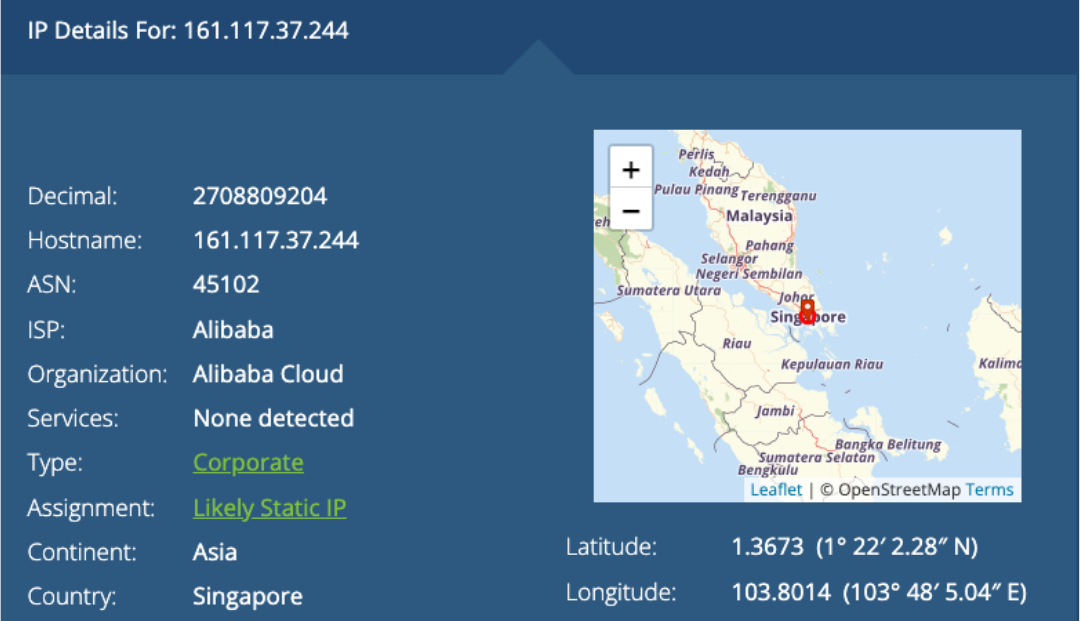
Apparently, the ISP/Organization turns out to be Alibaba and Alibaba Cloud, which is a cloud service provider, relatively.
A datacenter proxy is a proxy generated from a datacenter IP subnet on a datacenter server. Basically, this type of proxies are provided by cloud providers such as Amazon Cloud, Ucloud, Vultr, or Digital Ocean.
The concept of a datacenter proxy is to host the proxy on a dedicated server in the data center and have the dedicated server act as an intermediary between our computer and the server.
What is residential IP?
When we browse on the Internet, we need to purchase internet service from internet service providers to access the internet via broadband, local DSL or fiber optic cable.
In this case, the website will receive the information of an IP address, which is the residential IP. You can also check the information of the service provider and the location on https://whatismyipaddress.com/.
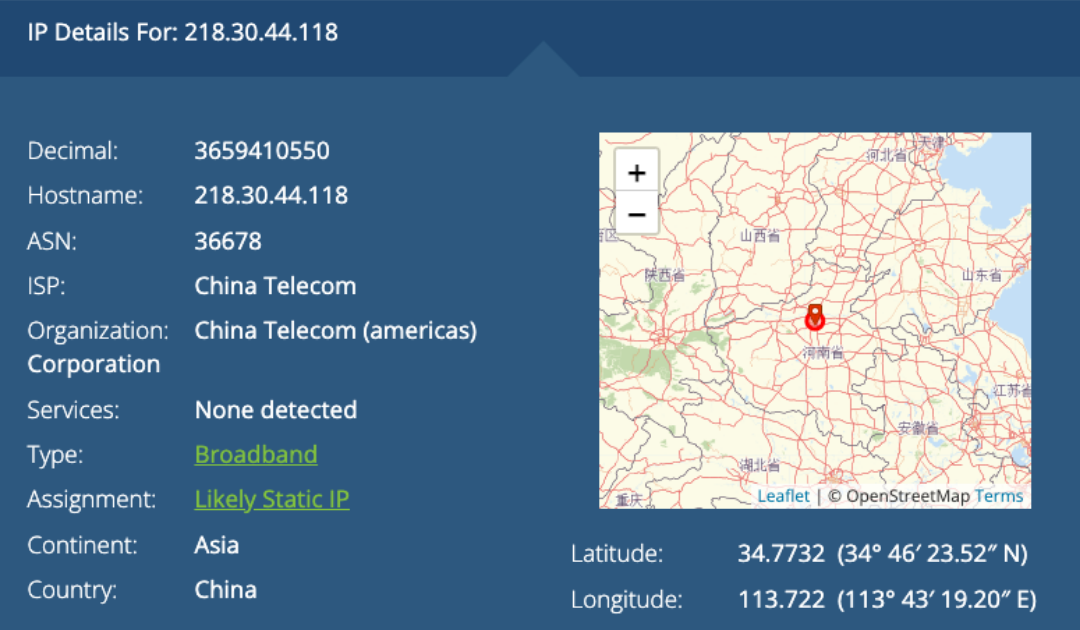
It should be noted that a residential IP address is a dynamic IP address that is managed and shared by the ISP. When we reboot our router or network, our IP address may change.
Datacenter IP vs. Residential IP
Both datacenter IP and residential IP are anonymous. They are both useful for people who need to stay anonymous online by leading the website to believe that you’re located in another place.
For example, if you live in the United States, when you access the web using a proxy from Argentina, the websites you visit will only see you as a visitor from Argentina.
Now, the question is, what is the difference between the datacenter IP and residential IP?
Looking at their definitions, it is clear that the residential IP is provided by the ISP, while the data center proxy is obtained from some service provider.
Here we list some key arguments for comparison to help you understand exactly what type of proxy is more suitable for you!
Datacenter IP
-
Faster network speed
Datacenter IPs are faster than residential IPs as almost all of this type of proxies are hosted on super fast dedicated servers in data centers all over the world.
So it's much easier to find a proxy located near our real location and can get a faster Internet connection.
-
More stable performance
A dedicated server in a data center is usually up and running 99.9% of the time, giving us more robust and reliable support.
-
More affordable
Compared to the high demand from market and supply shortage of residential IP, datacenter IP is less costly.
Residential IP
-
Web services trust residential IPs
Datacenter IPs are more readily available, leading to massive abuse by people. In contrast, residential IPs are linked to home addresses and are a service provided by Internet service providers compared, so web server security systems usually have more confidence in residential IPs.
-
Ensured reliability and security
Residential proxies are more widely used because of their reliability and security.
Which proxies should we choose?
Only if we figure out the differences between the two types of proxies can we choose the right one based on our needs.
If we need fast and reliable IPs to boost efficiency of our work, there is no doubt that datacenter IPs should be our first choice.
If we need dozens of IP addresses to cope with various tasks, such as account creation, web crawling, etc., residential proxies will be a better fit.
In most cases, datacenter IPs are stable. However, on some sites, the IP detection system may directly send a red flag to a visitor that comes from a datacenter IP. In this situation, a residential IP would be a rather prudent choice.
No matter what kind of proxies you use, you can use them in AdsPower to effectively mask your device fingerprints and run multiple accounts without being suspended.
