

What is the Difference between VoIP and Non-VoIP
Take a Quick Look
Understand the key differences between VoIP and non-VoIP numbers for account verification, and choose the right option to avoid failures. Improve your setup and verification success—start using smarter number solutions today.
If you have ever tried to sign up for an account and got stuck at the phone verification step, you have probably run into the difference between VoIP and non VoIP numbers without realizing it. On the surface, every phone number looks the same. But to online platforms, they are not equal at all. Some numbers receive codes instantly. Others fail, get delayed, or are rejected completely.
In reality, the difference between these two types of numbers only becomes obvious when you actually start using them. On paper, it might sound like a small technical detail. But once you are dealing with multiple accounts, or trying to scale anything beyond a few signups, it starts to matter a lot more than you expect. In setups like this, people often combine different tools, including proxy services for multi-accounting, to keep accounts stable and avoid unnecessary flags. Choose the wrong type of number, and you end up dealing with failed verifications, missing codes, or accounts getting restricted for no obvious reason. Choose the right one, and the whole process feels much smoother.
What Is a VoIP Number?
One of the reasons VoIP numbers are so popular is simply because they are easy to get and even easier to use.
You can set one up in just a few minutes, sometimes choose a specific country, and start using it right away. No SIM card, no extra device, no waiting around for activation. That convenience is hard to beat.
VoIP numbers usually show up in pretty practical situations, especially when people just need something fast and don't want to deal with SIM cards or extra devices. In practice, people usually reach for VoIP numbers in fairly straightforward situations:
- When a support team needs one number that everyone can log into
- When you just want to sign up for something and don't plan to keep it
- When you're trying out a feature or testing how a system works
- When you need a few temporary accounts running at the same time
Nothing complicated here. Most of the time, the goal is just to get a number quickly and move on. Get a number, use it quickly, move on. And for that, VoIP works just fine.
That said, this is also where some of the friction starts to appear. Because these numbers are so easy to spin up and reuse, platforms tend to be a bit more cautious with them. You might run into situations where a code takes longer than expected, or does not arrive at all. Sometimes a number just gets rejected without any clear reason.
It is not random. Platforms that deal with higher risk or try to limit automated behavior are usually stricter, and VoIP numbers are often the first thing they question.
What Is a Non VoIP Number?
A non-VOIP number is basically what most people are used to. It is issued by a mobile carrier and linked to a physical SIM card, so it exists within the traditional telecom system.
That connection to real infrastructure makes a difference. From a platform's point of view, these numbers look more legitimate because they are tied to actual devices and real network usage, not just something generated online. It is connected to an actual device, real network usage, and often some form of identity or billing record. All of this makes it look more trustworthy compared to virtual numbers.
In practice, you would rely on non-VoIP numbers when you care more about stability than speed. For example:
- When creating accounts you plan to keep for a long time
- When you need verification codes to arrive consistently
- When dealing with stricter platforms like social media or finance apps
- When account security and recovery actually matter
They are not as fast to set up, and they are definitely harder to scale. You usually need a SIM card, and in some cases, personal registration as well. It takes more effort, but that is exactly why platforms trust them more.
Once they are in place, though, they tend to be far more reliable in everyday use.
VoIP vs. Non-VoIP: Key Differences
At a basic level, the difference between these two types of numbers comes down to how they are built and how they behave in real world use. But the more important difference is how platforms respond to them.
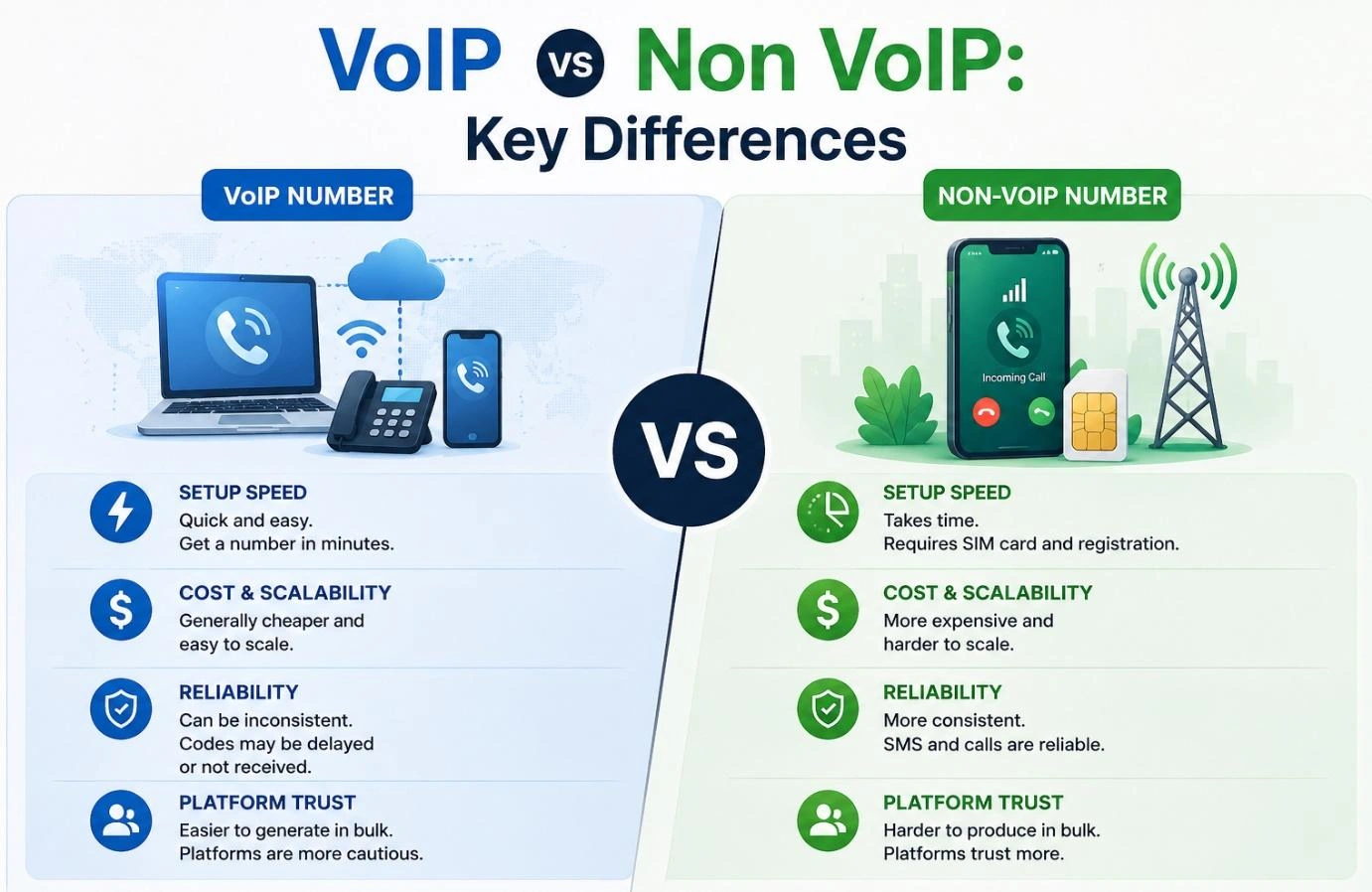
VoIP numbers operate over the internet, while non-VoIP numbers rely on traditional telecom infrastructure. That alone creates a gap in how they are perceived.
When you actually start using both types, the differences become pretty obvious. Not in theory, but in how things behave day to day:
Setup speed
With VoIP, you can get a number almost right away. No waiting, no setup beyond a few clicks. Non VoIP is different. You need a SIM card, sometimes even register it, and go through a carrier.
Cost and scalability
If you only need one or two numbers, the cost difference is not a big deal. But once you scale up, it shows. VoIP stays relatively cheap and easy to expand, while non VoIP quickly becomes harder to manage and more expensive.
Reliability
This is something people usually notice after a while. Non-VoIP numbers tend to receive SMS and calls without much trouble. VoIP can work fine, but it is not always consistent. Some codes arrive instantly, others don't show up at all.
Platform trust
This is probably the biggest difference. Non-VOIP numbers are harder to produce in bulk, so platforms tend to trust them more. VoIP numbers, on the other hand, are easier to generate, which makes platforms treat them more cautiously.
At first, these differences might not seem like a big deal. But once you start dealing with account verification, especially on stricter platforms, they become hard to ignore.
Why Platforms Treat VoIP and Non VoIP Differently
If you look at it from the platform's side, the logic is actually quite simple. Their main concern is not the type of number itself, but the risk behind it. They want to keep spam, fake accounts, and automated activity under control.
VoIP numbers just happen to be easier to create in large numbers. You can spin up dozens, even hundreds, without much effort. Because of that, they are often associated with bulk registrations or scripted behavior. Over time, platforms have picked up on these patterns and adjusted how they handle them.
That is why you will often see things like:
- Some platforms are refusing VoIP numbers altogether
- Limits on how many times a number can be used
- Verification codes arriving late, or not arriving at all
On the other hand, non VoIP numbers are tied to actual devices and mobile networks. They are harder to produce at scale and usually linked to real users. From a system's point of view, that makes them look more reliable.
It does not mean VoIP numbers are inherently bad. It is more about how easy they are to misuse when someone is trying to operate at scale.
Cloud Number for Scalable Account Management
Once you start handling more than a few accounts, a trade-off becomes hard to ignore.
- VoIP makes things fast and easy, but it does not always pass verification smoothly.
- Non VoIP feels more stable, but managing multiple SIM cards quickly turns into a hassle.
At some point, neither option feels quite right. That is usually when people start looking for something in between, something that can scale without constantly running into verification issues.
That is where cloud based number solutions come into play.
What Is DuoPlus Cloud Number?
DuoPlus Cloud Number gives you access to both VoIP and non-VoIP (physical SIM) numbers in one place. Instead of relying purely on VoIP or dealing with physical SIM cards, it gives you access to numbers that are handled in the cloud, but still behave closer to real mobile numbers when platforms check them.
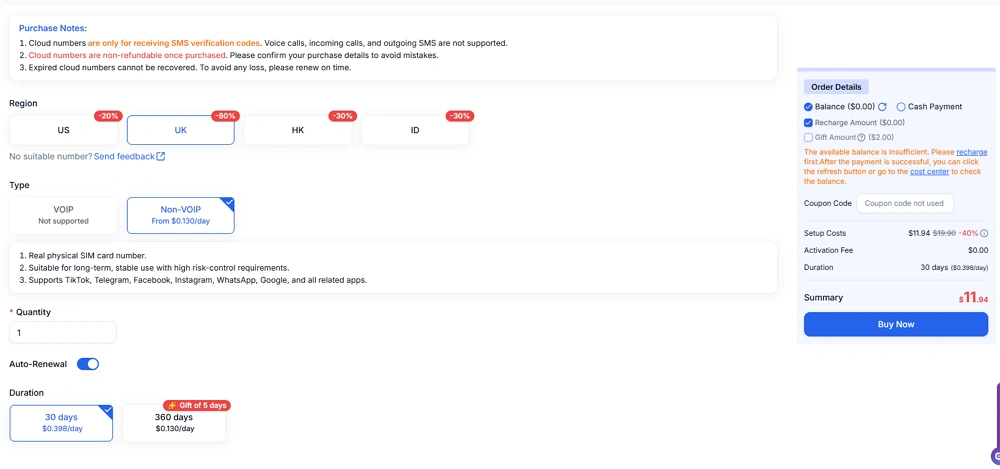
For anyone working with multiple accounts, this makes a noticeable difference. You are not just getting numbers faster; you are also improving the chances that those numbers actually work during verification.
Another thing people tend to like is how everything sits in one place. No switching between devices, no juggling SIM cards, no separate tools for each step. It is all managed inside a single system.
Key Features
What stands out is not just the numbers themselves, but how they fit into the workflow.
- You can manage several numbers from one dashboard instead of spreading them across devices
- Verification becomes less manual since codes can be handled automatically in the background
- It works with cloud phone environments, which helps keep sessions stable over time
- There is no need to deal with physical SIM cards, which removes a lot of operational friction
Individually, these things might seem small. But together, they make the whole process much easier to handle, especially at scale.
How to Get the Cloud Number
Getting started does not involve anything complicated.
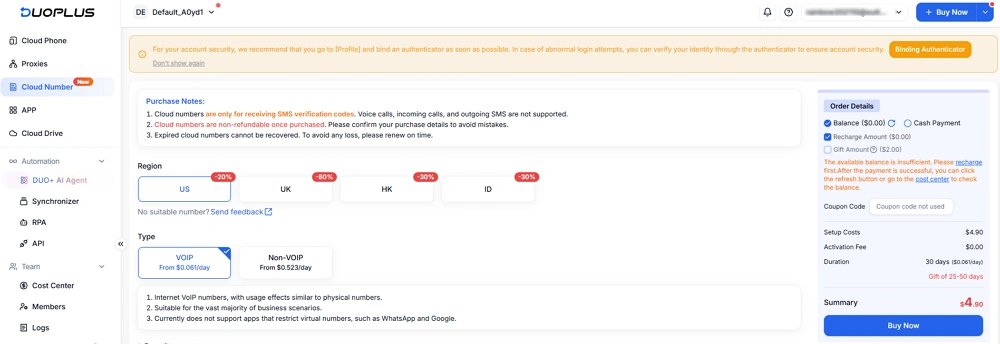
You begin by purchasing a cloud number through DuoPlus. After that, you link it to a cloud phone environment so everything stays connected. From there, most of the heavy lifting, including registration and verification, can be handled automatically.
Once it is set up, you are not constantly stepping in to manage every detail. The system takes care of most of it in the background.
Final Thoughts: VoIP vs Non VoIP — Which One Wins?
There is no one-size-fits-all answer here, because it really depends on what you are trying to do. VoIP works well when you care about speed, flexibility, and keeping costs low, especially for short term or high volume use. Non-VOIP, on the other hand, makes more sense when you need consistency, stronger trust from platforms, and long-term account stability.
If you are managing things at a larger scale, relying on just one option can feel limiting, which is why many people end up looking for something in between. Cloud number solutions are designed with that in mind, giving you a way to handle accounts more efficiently while still keeping verification and reliability at a reasonable level.
FAQ
Can VoIP numbers receive SMS verification codes?
Yes, but not always reliably. Some platforms still allow VoIP numbers, while others block them or limit their usage. Even when supported, delivery can be inconsistent, especially on services with stricter security checks.
Are non-VoIP numbers safer?
In most cases, yes. Because they are tied to real SIM cards and mobile networks, platforms tend to trust them more. This makes them less likely to be flagged, restricted, or rejected during verification.
What is the best number type for account verification?
If reliability is your priority, non-VoIP numbers are usually the better choice. If you need flexibility or scale, VoIP or cloud based numbers may be more practical. It depends on how you plan to use the account.

People Also Read
- Best Private Search Engines in 2026: 5 Secure Alternatives to Google

Best Private Search Engines in 2026: 5 Secure Alternatives to Google
Looking for a more private way to search? Explore the 5 best private search engines in 2026 and see how DuckDuckGo, Brave Search, Startpage, and more
- Temp Gmail: How to Create a Temporary Gmail Account in 2026
Temp Gmail: How to Create a Temporary Gmail Account in 2026
Learn how to create a temp Gmail account, compare Gmail aliases and separate accounts, and manage multiple accounts with AdsPower.
- Understanding Persistent Browser Profiles for AI Agents: Why Do They Matter?

Understanding Persistent Browser Profiles for AI Agents: Why Do They Matter?
Learn why persistent browser profiles matter for AI agents, helping maintain sessions, browser consistency, account isolation, and reliable automation
- Kickass Torrents Alternatives: Movies, TV, Games & Safe Access (2026)
Kickass Torrents Alternatives: Movies, TV, Games & Safe Access (2026)
Kickass Torrents is no longer what it once was, but there are still alternatives for finding movies, TV shows, music, books, games, and software. This
- AdsPower Proxy: Buy and Configure Proxies in One Place
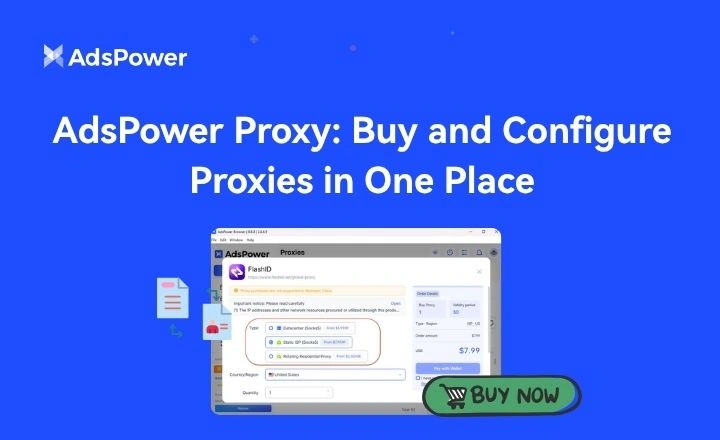
AdsPower Proxy: Buy and Configure Proxies in One Place
Buy an AdsPower proxy while creating a profile, configure it automatically, or continue using your preferred third-party proxy provider.
