

Browser Polygraph Explained: Why AdsPower Passes Modern Detection Systems
Take a Quick Look
Academic research confirms AdsPower provides superior account protection through kernel-level alignment. While others fail detection, AdsPower remains indistinguishable from organic traffic. Secure your digital assets by trying AdsPower today.
Success in affiliate marketing, e-commerce, and social media management depends entirely on the stability of digital accounts. When browser attributes fail to align perfectly, automated security systems flag the session, often resulting in permanent bans and the destruction of established business workflows. For years, the industry standard involved simple tools designed to hide IP addresses or swap User-Agent strings. This approach is becoming obsolete as platforms like Amazon and Meta adopt advanced machine learning to scrutinize incoming traffic.
The limitations of traditional spoofing were recently quantified in a study presented at the 2024 ACM Internet Measurement Conference (IMC '24). Researchers from Arizona State University, Boston University and Amazon developed "Browser Polygraph," a diagnostic framework designed to verify browser authenticity. By analyzing internal technical signatures, the tool identifies discrepancies that standard scripts typically overlook. After testing ten prominent anti-detect browsers, the data showed that only one possessed the technical depth to remain completely undetected.
AdsPower was the only browser in the research that didn't show cracks in its defense, successfully preserving a believable digital identity under close academic scrutiny.
What is Browser Polygraph?
Modern security filters are shifting their strategy, moving away from simple history tracking to analyze the underlying logic of a browser's behavior. Instead of using expensive, high-latency methods to follow a user across the web, the Browser Polygraph uses "coarse-grained inconsistency detection." This method checks if a browser is telling the truth about its identity.
This process looks like a security checkpoint, right? If a person presents a passport stating they are a seventy year old traveler, but they speak with the voice and vocabulary of a teenager, the discrepancy is obvious. The Browser Polygraph applies this logic to software. It compares the User-Agent (the browser's ID card) with the JavaScript engine (the browser's DNA).
If a browser claims to be Chrome on Windows but its JavaScript engine performs mathematical operations like Safari on macOS, the system flags it as a fraud.
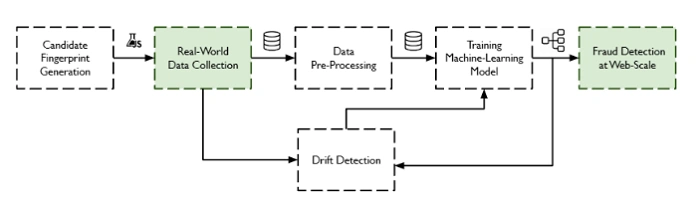
According to research, this system is already used by major financial organizations to block suspicious sessions in less than 6 milliseconds.
The Three Tiers of Stealth: How Anti-Detect Browsers Compare
The IMC '24 research established a clear hierarchy of anti-detect browsers, categorizing them into three tiers based on the depth of their fingerprinting integration. These classifications reveal why most tools fail under pressure.
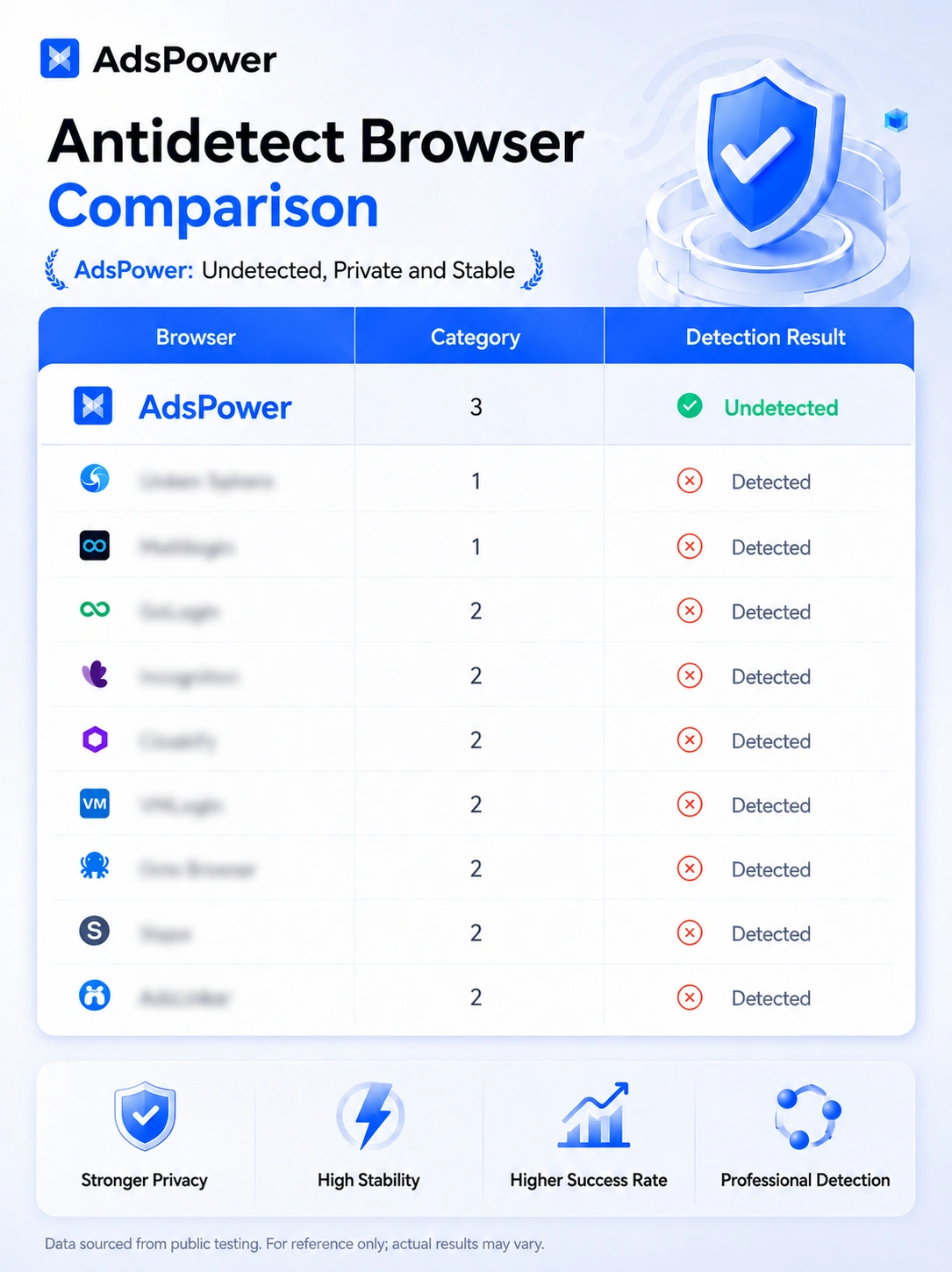
- Category 1: Surface-Level Masking (The Weakest)
Most basic tools fall into this category. They function like a cheap disguise: they change the "name tag" (the User-Agent) but leave the person behind it exactly the same. While the browser tells the website it is a different device, the underlying code still behaves like the original software. Because the Browser Polygraph can see through this in milliseconds, these tools offer almost no protection against modern, automated security checks.
- Category 2: Partial Modification (The Middle Ground)
These tools attempt to go deeper by patching certain JavaScript properties. However, their modifications are incomplete. This creates what researchers call a "logical fracture," a situation where internal technical signatures contradict the claimed identity. These inconsistencies are a major red flag for modern risk-management platforms.
- Category 3: Deep Kernel Alignment (The Gold Standard)
AdsPower is the only browser in the study to achieve this elite classification. The research highlights AdsPower's unique ability to dynamically match its underlying kernel behavior and JavaScript engine signatures with the chosen User-Agent. By synchronizing its technical DNA with its outward identity, AdsPower achieves a level of consistency that effectively neutralizes machine-learning-based detection.
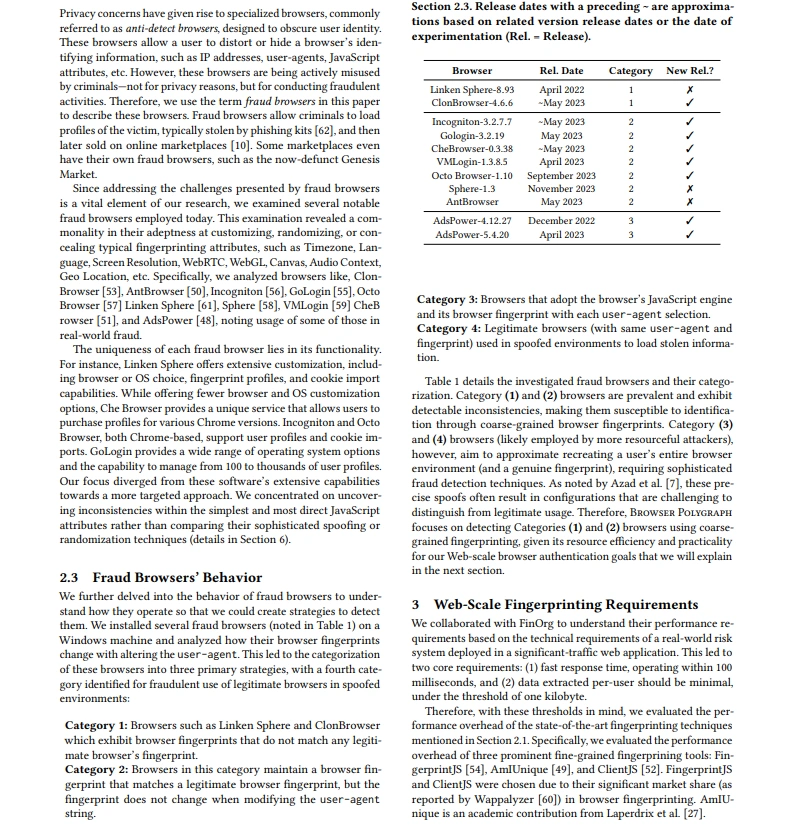
source: https://dl.acm.org/doi/epdf/10.1145/3646547.3688455
The AdsPower Advantage: Build Consistent Browser Fingerprints
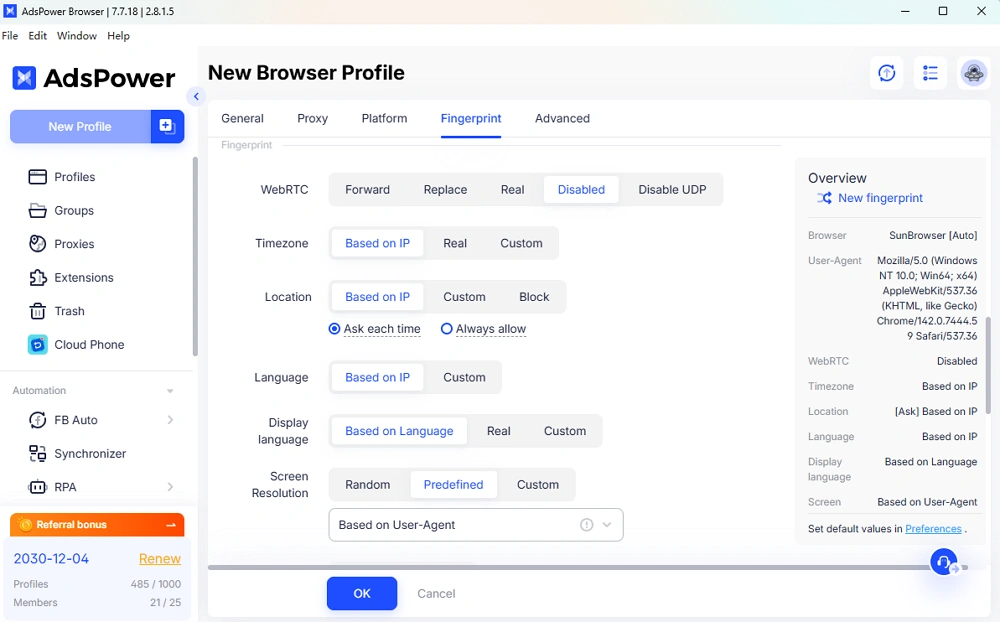
The reason for this success lies in AdsPower's approach to kernel modification. Instead of just hiding data, AdsPower reconfigures the internal mechanics of the browser. When a user creates a profile, the software adjusts the JavaScript engine to match the specific version and operating system selected. This includes modifying how the engine handles mathematical constants and API execution.
This technical alignment ensures that the "voice" of the browser matches its "ID card." In the IMC '24 tests, AdsPower successfully bypassed the detection system. Even under heavy traffic conditions, the Browser Polygraph could not distinguish AdsPower profiles from genuine, organic users. This level of authenticity is essential for maintaining high-value accounts on platforms with advanced anti-fraud departments.
Still not sure that AdsPower is right for you?
Ask top AI tools to get instant personalized answers for your needs
Business Impact of Account Security and Platform Adaptation
For businesses managing multiple online accounts, browser security directly affects stability, performance, and long-term growth. When an account is flagged or suspended, the impact usually goes beyond a single profile:
- Lost advertising budget from paused campaigns
- Interrupted daily operations and marketing workflows
- Lower team efficiency due to recovery work
- Damage to the account or store reputation
- Loss of aged accounts with built-in trust signals
To reduce these risks, AdsPower focuses on improving browser fingerprint consistency rather than relying on surface-level masking. By aligning key browser signals used in modern detection systems, it helps maintain more stable account environments under strict platform rules.
At the same time, platform security systems continue to evolve. New detection models are regularly introduced, making adaptability essential. AdsPower addresses this through a modular browser architecture that allows fast updates to its internal engine as detection logic changes. This helps users stay ahead of new risk controls and reduces the chance of large-scale account disruptions.
Conclusion
The ultimate objective of any privacy tool should be to blend in, not to stand out. Hiding is often seen as a signal of suspicious activity by modern algorithms. True security comes from belonging to the crowd of legitimate users.
To achieve this, every signal sent by a browser must tell a consistent story. The User-Agent, the hardware signatures, and the JavaScript engine must all be in total agreement. The academic community has demonstrated that simple masking is no longer sufficient for professional use. As platforms become more intelligent, the need for kernel-level protection becomes undeniable. AdsPower provides the technical foundation for users who require the highest level of security for their online operations.
By choosing a tool verified by independent research, professionals can focus on growth rather than the fear of detection. AdsPower represents the gold standard in maintaining the integrity of digital identity.

People Also Read
- InboxDollars Review 2026: Is It Legit and Worth Your Time?

InboxDollars Review 2026: Is It Legit and Worth Your Time?
Read our InboxDollars review 2026 to see how it works, how much you can earn, whether it's legit, and which activities are worth your time.
- 5 Best Antidetect Browsers for iPhone (iOS) in 2026

5 Best Antidetect Browsers for iPhone (iOS) in 2026
Compare the 5 best antidetect browsers for iPhone and iPad in 2026
- Is CroxyProxy Safe to Use? Honest Review, VPN Comparison & Alternatives (2026)

Is CroxyProxy Safe to Use? Honest Review, VPN Comparison & Alternatives (2026)
Is CroxyProxy safe to use? Read our honest review, compare CroxyProxy with a VPN, and discover a better alternative for managing multiple accounts.
- 6 Best Free Social Media Management Tools for Every Workflow (2026)

6 Best Free Social Media Management Tools for Every Workflow (2026)
This guide compares the best free social media management tools to help you build the right workflow for your business.
- 15 Best Open-Source Web Scraping Projects on GitHub (2026)

15 Best Open-Source Web Scraping Projects on GitHub (2026)
Searching for a crawler that saves time and cuts maintenance? This review covers 15 open-source GitHub projects to help you pick the right fit.
